/cover.png)
You paste a lecture PDF into ChatGPT, get a decent summary, ask two follow-ups, and close the tab. Next week you open a fresh chat and it has no idea who you are, what you're studying, or which concepts you got wrong last time. You do the same work again.
That's not a flaw in ChatGPT. It's a mismatch. ChatGPT is a general-purpose assistant that answers whatever you bring it, and it's genuinely excellent at that. But studying isn't a series of one-off questions — it's a cycle: take in material, organize it, review it actively over days, and test yourself before the exam. ChatGPT only really participates in one step of that, and only when you manually feed it your content every single session.
So when people go looking for AI study tools that are better than ChatGPT, the useful answer isn't "ChatGPT is bad, use this instead." It's more like seeing a specialist instead of a GP. Most lists of ChatGPT alternatives miss this — they hand you fifteen general-purpose chatbots that do the same thing ChatGPT already does. Apps like ChatGPT aren't what you need; apps that do the parts ChatGPT skips are. Below are seven tools that each beat it at a specific job in the study cycle — and an honest section at the end on the tasks where you should just keep using ChatGPT.
Full disclosure up front: one of these tools, Neuronity, is mine. I've kept it on the list because it does a job the others don't, and I've been just as direct about what it can't do. I've spent the last several months building in this space and testing the alternatives with real course material — uploading actual lecture slides, generating actual study sets, and seeing what survives contact with a real deadline. Pricing was verified against each vendor's site in July 2026.
Where ChatGPT actually falls short for studying
Before the list, it's worth being precise about the gaps — because the right tool depends on which gap is hurting you.
It doesn't persist. Each conversation starts from zero. It doesn't track which topics you keep missing or schedule review of the ones you're weakest on.
It doesn't structure. Ask it to teach you thermodynamics and you get a wall of text. There's no sectioned plan, no sense of where you are in a topic, no checkpoint that stops you and asks whether you actually followed that.
It's passive by default. It hands you answers. Learning happens when you retrieve information, not when you read it. Unless you deliberately prompt it to quiz you every session, it will happily just explain things while you nod along.
It isn't grounded in your material. Unless you upload something each time, it answers from general knowledge — which is how you end up with a confidently wrong detail that isn't what your professor taught.
Each tool below closes one of those gaps. This isn't a ranking — the order is arbitrary, and the tool that matters is whichever one matches the gap that's actually costing you time.
1. NotebookLM — better than ChatGPT for trusting the answer
The gap it closes: grounding and verification.
Google's NotebookLM only answers from the documents you upload, and it puts a citation on every claim pointing back to the exact passage. That kills the biggest anxiety of using a chatbot for coursework: not knowing whether it's repeating your professor's material or improvising.
/Screenshot%202026-07-13%20191936.png)
Better than ChatGPT for: interrogating a stack of readings, research papers, or dense textbook chapters where you must be able to verify every answer.
Not better for: flashcards, quizzes, or spaced review — it doesn't do them.
Price: Free with a Google account.
2. Quizlet — better than ChatGPT for memorization
The gap it closes: active recall on term-heavy material.
ChatGPT will explain a term as many times as you like, which feels productive and mostly isn't. Quizlet drills you, tracks what you miss, and brings it back. Its library of community-made sets is enormous, so for a standard course, a solid deck often already exists.
/Screenshot%202026-07-13%20191853.png)
Better than ChatGPT for: vocabulary, anatomy, pharmacology, law cases — anything where the challenge is volume of terms.
Not better for: concept-driven courses where understanding, not memorizing, is the bottleneck.
Price: Free to study existing sets; Quizlet Plus around $7.99/mo.
3. Anki — better than ChatGPT for remembering it in three months
The gap it closes: long-term retention.
Anki's spaced-repetition scheduler is the most proven tool on this list, and it does the one thing ChatGPT structurally cannot: it knows what you forgot and when to show it to you again. If you're preparing for cumulative exams — med school, languages, professional boards — nothing else comes close.
/Screenshot%202026-07-13%20192022.png)
Better than ChatGPT for: durable, months-long retention.
Not better for: speed. You build the cards, and the learning curve is real.
Price: Free on desktop and Android; the iOS app is a one-time purchase.
4. Neuronity — better than ChatGPT for learning a topic in a structured way
The gap it closes: structure and active practice, from your own materials.
This is the one built for the "I don't understand this yet and I have a week" problem. Instead of a chat box, you create a course, upload your actual notes, slides, or PDFs (or just type a goal), and Neuronity organizes it into a sectioned lesson plan — then teaches you through it, section by section, rather than dumping everything at once.
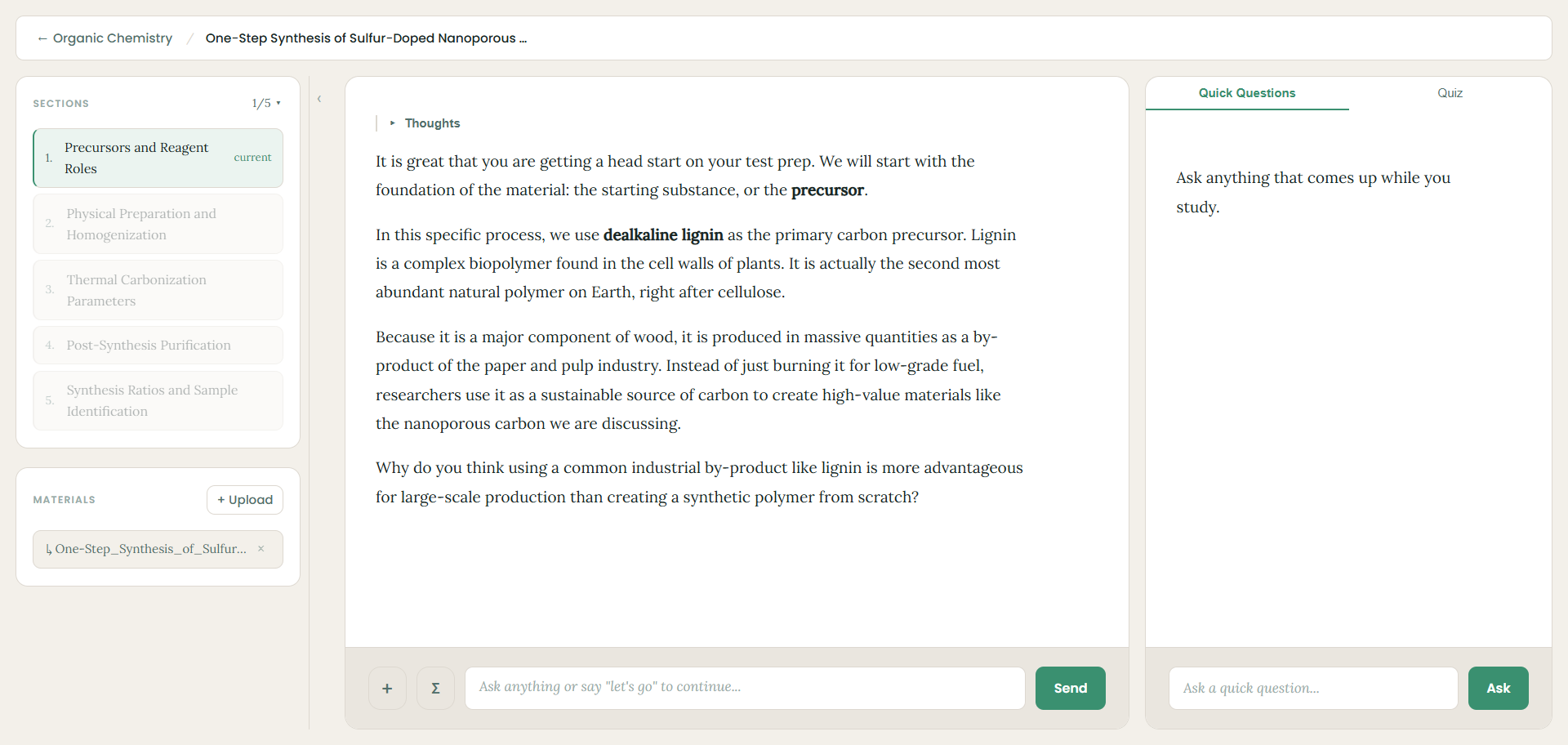
The difference from ChatGPT is the shape of the interaction. ChatGPT waits for you to ask the right question. Neuronity works through a plan, explains an idea, then hits a checkpoint with a practice problem to make sure it landed before moving on. If something confuses you mid-lesson, a Quick Questions panel answers it without losing your place in the lesson. When you're done, the Quiz tab generates a test at the difficulty and length you choose.
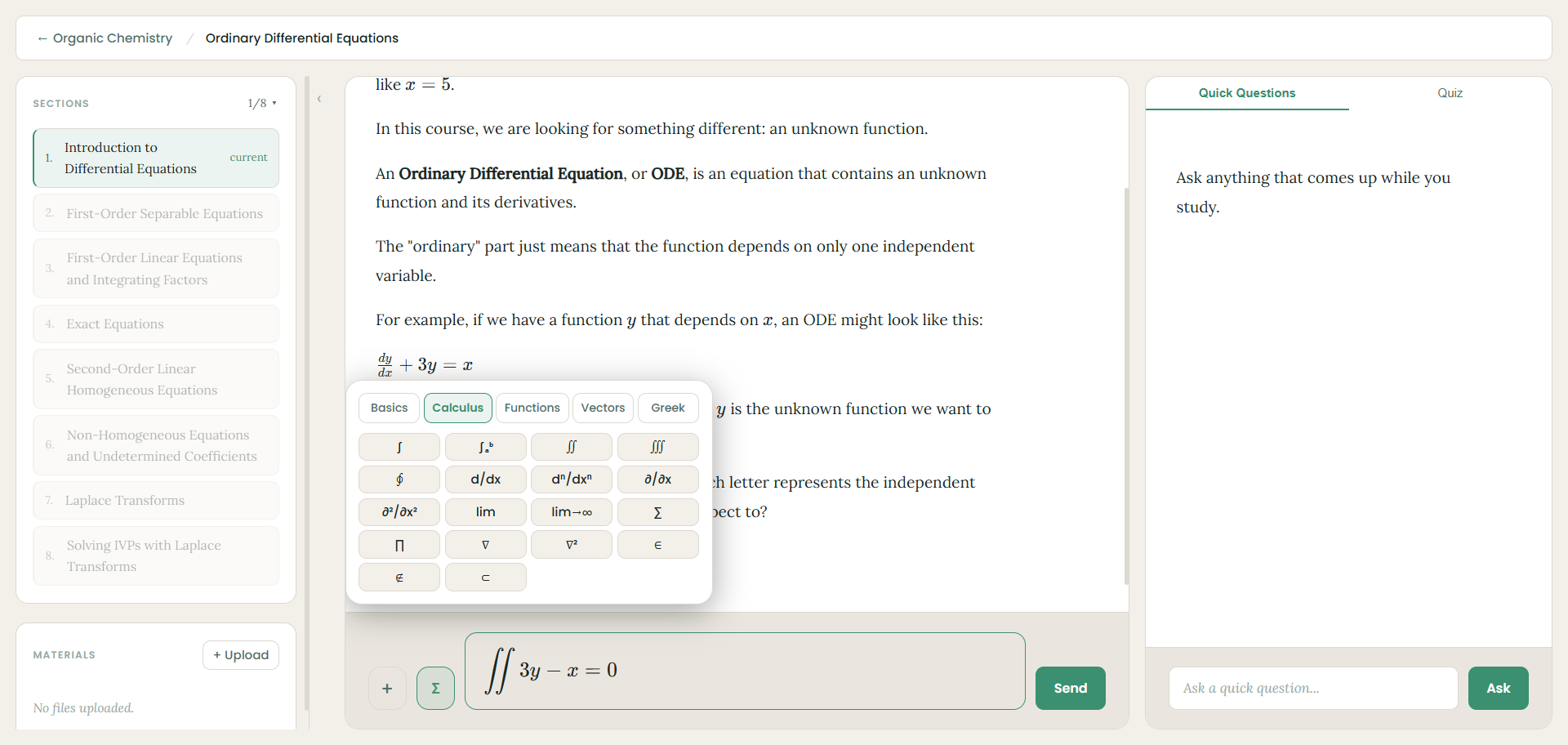
For STEM students there's a practical detail ChatGPT genuinely doesn't match: a built-in scientific keypad (Basics, Calculus, Functions, Vectors, Greek) so you can type an integral or a vector into your answer instead of fighting with plain text.
Better than ChatGPT for: learning something new from your own materials, with structure and built-in practice.
Not better for: long-horizon spaced review (Anki wins), pre-made flashcard libraries (Quizlet wins), or open-ended brainstorming (ChatGPT wins).
Price: Core tutor and course creation are free; a paid plan lifts daily limits. Try Neuronity free
5. Khanmigo — better than ChatGPT for being taught, not told
The gap it closes: Socratic guidance instead of answers.
Khan Academy's Khanmigo tutor deliberately refuses to hand you the solution. It asks what you think happens next and guides you to it, which is slower and considerably more effective than reading a worked answer. It's tightly integrated with Khan's K-12 library across math, science, and more.
/khanmigo.png)
Better than ChatGPT for: K-12 and early-undergrad fundamentals where you need to build the reasoning yourself.
Not better for: advanced or niche university coursework outside Khan's curriculum.
Price: Low-cost subscription; free for many teachers and districts.
6. Perplexity — better than ChatGPT for research with sources
The gap it closes: citations you can actually put in a bibliography.
Perplexity searches live and returns answers with linked sources, which matters when you're writing a paper and every claim needs a reference. Free ChatGPT is far weaker here.
/perplexity.jpg)
Better than ChatGPT for: research assignments, literature scoping, anything needing verifiable citations.
Not better for: teaching you a concept or drilling you on it.
Price: Generous free tier; Pro around $20/mo.
7. StudyFetch — better than ChatGPT for lecture-heavy classes
The gap it closes: getting hours of multimedia into usable study material.
StudyFetch ingests what ChatGPT mostly can't: recorded lectures, audio, video, even photos of handwritten notes — and turns them into flashcards, quizzes, summaries, and a tutor grounded in your uploads.
/Screenshot%202026-07-13%20191725.png)
Better than ChatGPT for: courses that live in recordings and slides rather than text.
Not better for: evaluating cheaply — the free tier is around two uploads, and reviewers commonly flag auto-renewal friction, so set a cancellation reminder if you subscribe.
Price: Limited free tier; roughly $4.99/mo billed annually.
When you should just use ChatGPT
Any list like this that claims ChatGPT lost at everything is selling you something. It's still the best option for several real study tasks:
- Open-ended brainstorming — essay angles, project ideas, "what should I even argue here."
- Explaining something broad on demand when you don't need it grounded in a specific source.
- Essay structure and feedback — outlining, tightening an argument, spotting a weak paragraph.
- Quick one-off questions where a specialist tool is overkill.
A note on the obvious substitute: if you're looking for a free AI like ChatGPT, Google's Gemini is the closest match, and its Guided Learning mode pushes it further toward tutoring than plain ChatGPT goes. It's worth having. But it shares the same core limits — it's still a general assistant that starts fresh each session and won't structure a topic into a plan or hold you to a review schedule. Swapping one generalist chatbot for another doesn't fix the gaps above; that's the trap most ChatGPT alternative lists fall into.
The most effective setup for most students isn't picking a side. It's one specialist tool for the study cycle — capture, structure, practice, review — plus ChatGPT or Gemini for on-demand explanation and writing help when something isn't clicking. Forcing either one to do the other's job is where people get frustrated.
How to pick, in one minute
- "I don't understand the material." → Neuronity (guided lessons from your notes) or Khanmigo (Socratic, K-12).
- "I can't trust the answers." → NotebookLM.
- "I understand it, I just can't remember it." → Anki for the long haul, Quizlet for terms.
- "I'm drowning in lecture recordings." → StudyFetch.
- "I need real citations." → Perplexity.
- "I need to brainstorm or draft." → Stay in ChatGPT.
For a broader breakdown of study tools by category rather than by comparison to ChatGPT, see our guide to the best study apps for college students.
Frequently asked questions
Is ChatGPT good for studying?
Yes, for specific things — explaining a concept on demand, brainstorming, and giving feedback on your writing. It's weak at the rest of the study cycle: it doesn't remember what you struggled with, doesn't structure a topic into a plan, doesn't quiz you unless you ask, and isn't grounded in your course material unless you upload it every session.
What is better than ChatGPT for students?
It depends on the job. For guided learning from your own notes, Neuronity. For verifiable answers from your documents, NotebookLM. For memorization, Quizlet. For long-term retention, Anki. For research citations, Perplexity. For lecture recordings, StudyFetch. No single tool wins everything.
What's the best free ChatGPT alternative for students?
NotebookLM is free with a Google account, Anki is free on desktop, and Neuronity's core tutor is free with no card required. Between them you can cover grounded reading, retention, and guided learning without paying anything.
How do you use AI for studying?
Use it for the parts of the study cycle you can't do efficiently alone, not to skip the thinking. Practically: upload your notes or slides to a tool that grounds its answers in them, have it structure the material into a plan rather than a wall of text, work through it section by section, and — the step most people skip — get it to quiz you rather than explain to you. Retrieval is what builds memory; reading an explanation feels productive but does far less. Reserve ChatGPT for on-demand explanation and writing feedback when something isn't clicking.
What is the best AI for school work?
For understanding material and being quizzed on it, a structured tutor like Neuronity or Khanmigo. For essays and drafting, ChatGPT or Claude. For research with real citations, Perplexity or NotebookLM. For memorization, Quizlet or Anki. "School work" spans several different jobs, and no single AI is best at all of them — which is exactly why most students end up with two tools rather than one.
Is using AI to study cheating?
Using AI to produce work you submit as your own — writing the essay, generating answers you hand in — is plagiarism under most academic-integrity policies. Using AI to help you learn — explaining concepts, generating practice questions, quizzing you, turning your notes into a study plan — is a legitimate study method, the same as a tutor or study group. The test is whether you're doing the thinking or outsourcing it. The tools above are most useful precisely when they make you practice.
What are the best free alternatives to ChatGPT for students?
For a free AI similar to ChatGPT, Gemini is the closest general-purpose substitute. But if the goal is studying rather than chatting, the free tools that actually add something are NotebookLM (grounded answers with citations from your own documents), Anki (free on desktop, best-in-class retention), and Neuronity (free core tutor that builds a guided lesson from your notes). Those three cover reading, review, and learning without a subscription between them.
Can AI study tools replace ChatGPT entirely?
For most students, no — and they don't need to. The realistic setup is a specialist tool for the structured study cycle plus ChatGPT for open-ended explanation and writing help.
About the author: Ashir builds Neuronity and tests study tools hands-on with real course material. Pricing and features were verified against vendor sites in July 2026 and change often — confirm before subscribing. Where a competitor beats Neuronity at a specific job, this guide says so.